By Thisuri Rojie Ekanayake
Worldwide, shocking news headlines about the impact of Artificial Intelligence or AI on jobs have been a plenty lately. Often, these articles attest that a large share of work is expected to be affected by AI, sparking concern of automation and mass layoffs at unprecedented rates. A closer investigation of the research behind the headlines reveals a much more complex scenario. From the specific definitions of AI adopted to the use of labour market data across vastly different regions, these studies leave something to be desired in their applicability to the Global South.
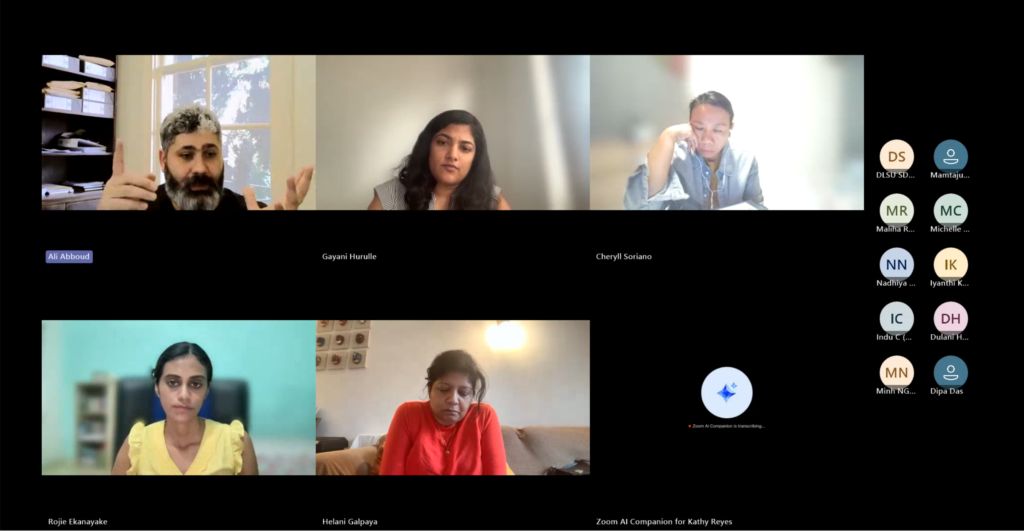
A recent FutureWORKS Asia knowledge-sharing session inquired into on these pertinent questions. The session comprised of two presentations, with the first by Gayani Hurulle, Senior Research Manager at LIRNEasia who shared insights on methods in AI exposure literature. This was followed by an introduction to the work done by the FutureWORKS South West Asia and North Africa (SWANA) Hub by Ali Abboud, PhD from the American University of Beirut.
Gayani traced the evolution of methods in influential AI exposure studies focusing on the definitions of AI, data sources and estimation techniques utilised. She highlighted both strengths and limitations in these existing methods and noted the need for nuance in depicting findings especially when applied to low and middle income countries in Asia. The novel method to estimate AI exposure in the SWANA region discussed by Ali was motivated by similar concerns. In essence this method combines human expertise with job advertisement data. The technique was adopted in response to the general scarcity of comprehensive labour data across many developing economies.
Understanding AI exposure
A significant portion of studies investigating AI impacts employ the concept of AI exposure. Ali described this as a forward-looking measure that quantifies the share of jobs in a given geographic region affected by AI. This does not differentiate between enhancing worker performance and replacing workers, known as the augmentation and displacement effects. Nevertheless . Ali highlighted that these two effects can in fact be considered two sides of the same coin: As AI adoption improves productivity, less human input is required for the same task, leading to potential employment losses.
Given the technology’s dynamic nature, it is essential to acknowledge the various definition of AI used to construct exposure measures. Gayani noted that the way in which AI is defined has changed considerably across the literature. Prior to 2022, AI exposure scores tended to rely on a broader understanding of capabilities such as decision making and pattern recognition. Since late 2022 with the public release of ChatGPT however, there has been an increasing shift in the focus of AI exposure studies towards the impact of generative AI, particularly Large Language Models (LLMs). Most recently, several authors including Dominski and Lee (2025) have begun differentiating between the capabilities of successive generations of LLMs, reflecting the rapid changes in the AI landscape. The job market impacts therefore tend to differ according to the specific scope and model of AI considered in the study.
Data scarcity and innovations in estimation
A major challenge in conducting AI exposure studies in the Global South arises from the limited availability of data. The seminal literature which mainly originates from the U.S., often relies on the O*NET database of the U.S. Department of Labour. This is a routinely updated database with a wide range of information including occupational groups, tasks,activities and worker requirements. Its occupational classification extending up to eight digits is far more granular than the International Standard Classification of Occupations (ISCO) available for most low and middle income countries extending to only a four-digit level. An example presented by Gayani showed that the O*NET database would categorize Orthopedic Surgeons in their own distinct group while the ISCO would classify them under the much broader classification of Specialist Medical Practitioners that consist of many other specialties.
This raises yet another question on whether occupations or job roles could be compared across regions as the labour market structures, technical qualifications required and economic conditions may differ from country to country. As previously mentioned, the desire to create an AI exposure index that more accurately reflects local circumstances has been a major motivation for the research conducted by FutureWORKS SWANA Hub. Their research involves the creating the following three indices to generate exposure scores for the labour force of the region:
- Skill exposure index
- Occupation exposure index
- Labour force exposure index
The research team follows a simple and replicable series of steps, the first of which is creating an index that evaluates how likely 9 AI abilities are at replacing 52 human skills, estimated by regional AI experts. Next, this skill exposure index is applied to jobs by identifying the skill composition of a given occupation, resulting in the occupational exposure index. Skill requirement data is obtained through key word searches in regional job advertisement platforms. Finally, the occupational exposure index is applied to national labour market data to obtain exposure at the country and regional levels.
Despite its utility in the face of data restrictions, Ali did acknowledge several limitations of this method such as job vacancy data being skewed to certain countries or sectors and the underrepresentation of certain skill requirements. In the long term, there is a case to be made for more extensive national and regional level labour market statistics to be made available for more accurate estimations.
How is AI exposure measured
Gayani identified several widely used methods of estimating AI exposure in the literature which were purely human estimation, estimation through a LLM, or a combination of the two. Earlier studies such as works of Felten et al. (2018, 2021) and Brynjolfsson et al. (2018) relied heavily on human expertise to determine AI exposure scores. This may have resulted in an overly enthusiastic view of AI adoption as they are less likely to account for infrastructural and technological readiness and willingness to adopt AI. The disparity between potential and actual AI adoption could therefore vary significantly. Yet studies entirely dependent on LLMs may also suffer limitations inherent in AI tools such as stereotyping and hallucinations despite their computational efficiency.
To create an exposure index that accurately reflects their specific region, the FutureWORKS SWANA Hub relied primarily on regional AI experts. To moderate these responses, they use a nuanced scale as opposed to yes or no style questions, ranging from fully capable to not capable. Furthermore, an additional layer of correction is made using Focus Group Discussions with other experts with a clearer understanding of the wider economic and legal conditions as well as LLM prompting
Lessons for the Global South
The discussion portion of the knowledge-sharing session raised several important questions on the novel method for calculating AI exposure presented by Ali. Participants reflected on the categorisation of jobs and skills across countries, the adequacy and representativeness of the underlying data, and how AI skills are conceptualized and their relevance over time. Given the region’s heavy reliance on migrant labor, participants also considered potential spillover effects on the countries of origin of workers resulting from AI-related changes to jobs. Ali acknowledged that while mitigation strategies have been employed to minimise the effects of several of these concerns, it may not be possible to address them entirely. Yet the research team remained confident that their measure would provide a reasonable lower-bound estimate of AI exposure in the region, especially in sectors most likely to be affected. The findings, he noted, should therefore be interpreted accordingly.
Consequently, to gain a realistic understanding of the effect of AI on jobs, it is clear that we must look beyond the numbers in the headlines and more closely scrutinize the sources and methods on which they are based. This is especially pertinent when methods and findings developed largely in the Global North are applied to a wholly different context. The work done by local research groups such as the FutureWORKS SWANA Hub is therefore essential in creating methodologies that are more sensitive region-specific constraints and realities.
This blog draws on insights from the policy note Interpreting AI Exposure Estimates: Implications for Low- and Middle-Income Countries by Gayani Hurulle and Rojie Ekanayake, which reviews forward-looking AI exposure methodologies, underlying occupational data sources such as O*NET and ISCO, and their relevance for labour-market analysis in LMIC contexts.
Read the full policy note below: