The Fourth Industrial Revolution is reshaping labour-force dynamics worldwide through a technological transition running alongside a green one, and Bangladesh is no exception. One of the sectors most exposed to this twin shift is the ready-made garments (RMG) industry. Bangladesh’s export basket is heavily concentrated in RMG, making it one of the country’s major economic drivers. It is also a labour-intensive sector, where Bangladesh has long competed with other countries on the strength of lower labour costs. A large share of that workforce is female, though notably, the female share has been declining over the years, a trend that sits at the heart of the questions this study set out to explore.
To understand how the technological and green transition is affecting labour dynamics in the RMG sector, particularly for marginalised groups such as women, the South Asian Network on Economic Modeling (SANEM), in collaboration with the Institute for Human Development (IHD), is jointly conducting a study titled “Gender Implications of the Future of Work in South Asia: Insights from Garment Manufacturing in Bangladesh and India.” IHD is leading the India component and SANEM the Bangladesh component. The study is supported by LIRNEasia under the FutureWORKSAsia initiative, supported by the International Development Research Centre (IDRC). As part of the sharing and validation of the study’s preliminary findings, a dedicated technical session titled “The Challenges of Technological Change and Climate Transition in Garment Manufacturing in Bangladesh and India” was organised at the 9th SANEM Annual Economists’ Conference (9SAEC). The session was held in hybrid mode on April 18, 2026.
The session was moderated by Selim Raihan, PhD (Executive Director, SANEM and Professor of Economics, University of Dhaka). Anwar-Ul-Alam Chowdhury (President, Bangladesh Chamber of Industries) and Saif Uddin Ahammad, PhD (Chief Executive Officer (Joint Secretary) of the Bangladesh Foreign Trade Institute), enriched the session as distinguished discussants. Alakh N. Sharma, PhD (Professor and Director, Institute for Human Development), joined as a special guest, and researchers from both the Bangladesh and India teams participated. Sachini Ranasinghe (Senior Researcher, LIRNEasia) joined online.
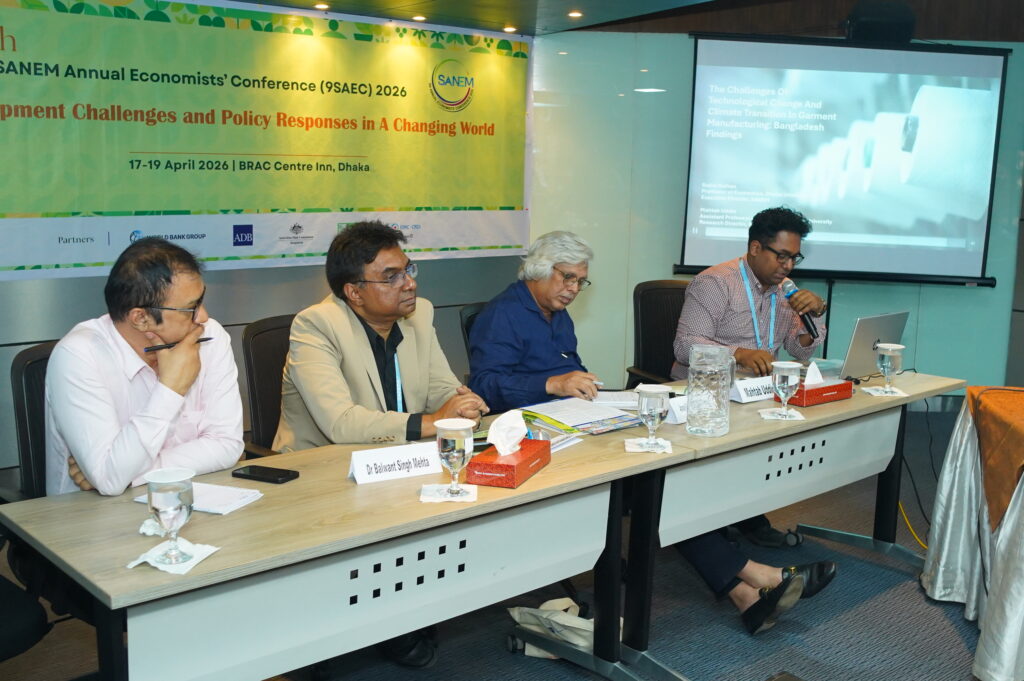
The Bangladesh presentation, by Mahtab Uddin (Research Director, SANEM), examined how automation and climate-adaptation technologies are transforming the country’s garment sector. Drawing on secondary data along with primary surveys of 100 employers and 200 workers, the study finds a sharply gendered job ladder, where women dominate low-tier roles like machine operation and quality checking but are almost entirely absent from supervisory, technical, and management positions. A wage decomposition analysis shows that part of the gender pay gap stems not just from differences in education or experience, but from unequal returns to those same characteristics.
On the employer side, adoption of automated cutting and sewing machines, energy-efficient systems, and digital quality control is already widespread, driven mainly by productivity gains and the desire to attract international buyers, and this has already fully or partially displaced workers in sewing, cutting, and administrative functions. Climate-friendly practices such as water-efficient machinery and waste management are similarly common, though often adopted for cost and compliance reasons. Workers report mixed effects because of automation: easier tasks in some cases but also growing pressure to learn new skills and fear of job loss. Women workers cite lack of training, safety concerns, and care responsibilities at home as barriers to advancing alongside these changes. The presentation calls for gender-responsive skill development, more inclusive technology upgrading, stronger social protection, and better governance and coordination among stakeholders.
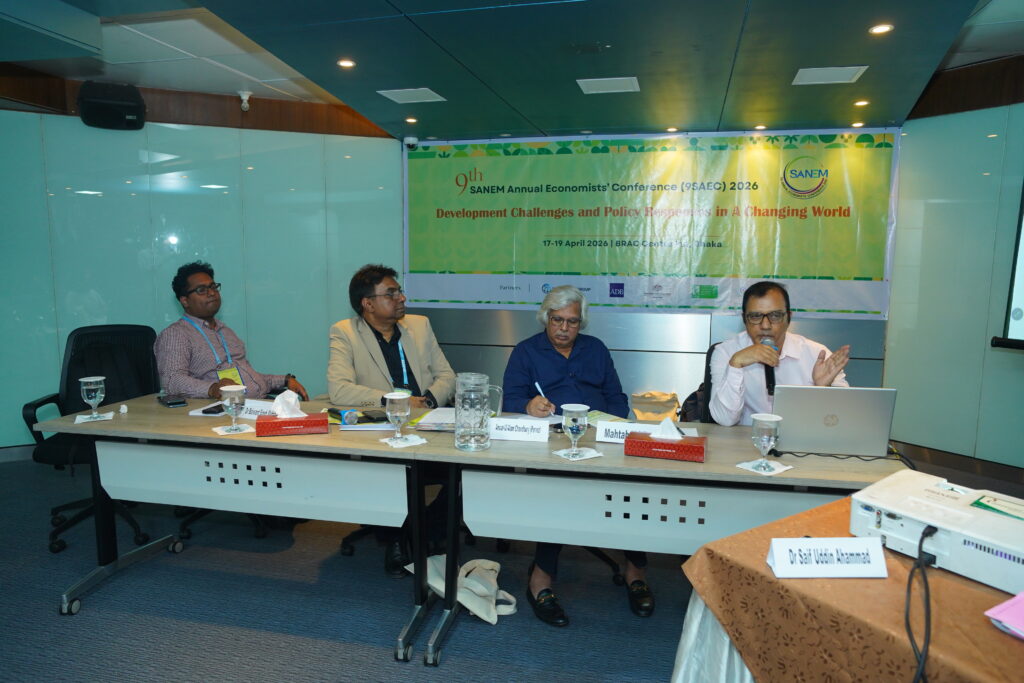
The India presentation, by Balwant Singh Mehta, PhD (Professor of Economics, Institute for Human Development), shared preliminary findings from a parallel study covering 203 workers and 100 firms across Delhi NCR and Bangalore. India’s garment sector remains dominated by small and micro enterprises with limited capital for technology investment. The surveyed workforce is largely female, middle-aged, and heavily reliant on migrant labour, with only about 11% holding technical qualifications. Job security is weak, with nearly half of workers lacking any written contract and many working long hours with widespread overtime. The study finds that 85.7% of workers have some exposure to workplace technology, but this is overwhelmingly basic automation (mechanisation) rather than AI, which remains concentrated in design, planning, and management functions at larger firms; smaller firms lag well behind due to cost and skill constraints.
Importantly, the research finds little evidence of large-scale job loss; only about 5% of workers fear displacement, but the study points to substantial task restructuring, rising pressure to acquire new skills, and a shift toward more contractual and flexible employment arrangements. Women report slightly higher technology exposure than men, but this hasn’t translated into better opportunities, as they remain concentrated in routine, automatable roles with less access to training, reinforcing existing inequalities. Access to formal training is limited, and firms themselves report receiving little external support to help them adopt new technology or reskill their workforce. The presentation concludes by calling for targeted support for MSMEs, expanded and demand-driven skills training, integrated policies linking technology adoption with reskilling and social protection, and specific measures to address the heightened vulnerability of women, migrants, and informal workers.

The presentations drew thoughtful responses from both discussants. Saif Uddin Ahammad, PhD (Bangladesh Foreign Trade Institute), stressed that Bangladesh must diversify beyond basic cotton RMG toward man-made fibres, technical textiles, and skill-based production, a shift made especially urgent by Bangladesh’s graduation from LDC status in 2026, after which it will lose duty-free and quota-free market access as well as cash incentives. He noted competitiveness must now come “based on innovation, technological upgradation, and skill development” rather than trade preferences. He also noted that around 60% of RMG workers are women, mostly semi-skilled or unskilled, making gender-focused skilling essential, and pointed to a wave of EU regulations (the Green Deal, CBAM, and the digital product passport) as looming compliance pressures. He also flagged circularity as increasingly essential, noting that Bangladesh generates roughly six lakh metric tons of garment waste annually.
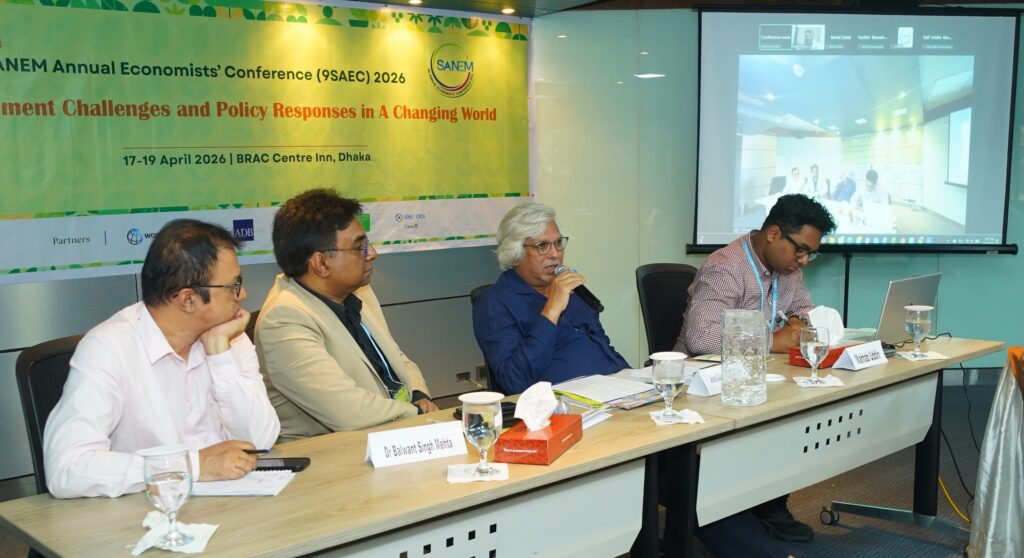
Anwar-Ul-Alam Chowdhury (President, Bangladesh Chamber of Industries) offered a note of caution on cross-country comparisons, arguing that Bangladesh’s wage levels and employment structures differ meaningfully from India’s, citing permanent (rather than contractual) employment as the norm in Bangladesh’s RMG sector, driven by international buyer compliance requirements, and higher wage levels than those referenced in the India presentation. Because the two studies covered different countries, cities, and sample frames, such divergences are perhaps to be expected rather than contradictory. He also emphasised that Bangladeshi entrepreneurs tend to invest early and aggressively in advanced machinery and stressed that full automation remains impractical for much of the sector given fast-changing fashion trends and small-batch orders. He also mentioned that technological transition on the ground is rarely uniform.
Taken together, both studies point to a similar story: automation in South Asia’s garment sector is reshaping tasks and skill demands more than it is eliminating jobs outright, but women and lower-skilled or informal workers are bearing a disproportionate share of the resulting pressure, through weaker access to training, thinner job security, and fewer pathways into higher-value roles. That makes inclusive skilling and stronger social protection a shared policy priority across both countries, and a defining test of whether this twin transition delivers broad-based gains or deepens the inequalities already built into the sector.

Offering the concluding remarks, Alakh N. Sharma, PhD (Professor and Director, Institute for Human Development), drew the discussion back to the bigger picture, noting that digital technologies and AI, alongside the climate and net-zero transition, are set to reshape not just the labour market and industry but the broader path of growth itself. He observed that while Bangladesh and India share broadly similar labour markets, they differ meaningfully in magnitude and process. In India, automation has so far taken hold only in selected sectors, and the garment sector is among the latest to begin that shift, leaving Bangladesh some way ahead on automation. The two countries also relate to the sector differently. For Bangladesh, RMG is effectively a lifeline, whereas in India it remains relatively smaller in scale but deeply tied to culture and to a wide web of forward and backward linkages. That, he argued, is precisely what makes this study so important. Rigorous evidence on technological and green transition in South Asia’s garment sector remains scarce, even as the pressure to adapt grows unavoidable. In the name of efficiency, and simply to survive and stay in the market, firms and workers alike must adjust to these shifts. He closed on a challenge that the study brings sharply into focus: many firms, especially in India, are small, decentralised, and often home-based, which makes them exceptionally hard to reach with support. How to bring these firms into the fold of modern and green technology adoption, he suggested, is one of the central questions the sector must now answer.