For millions of people across South and Southeast Asia, working abroad offers a path to better incomes and greater financial stability for their families. The Gulf Cooperation Council (GCC) countries – Bahrain, Kuwait, Oman, Qatar, Saudi Arabia and the United Arab Emirates – are important destinations for these workers, who are employed in sectors ranging from construction and healthcare to domestic and gig work.
Yet better income does not necessarily translate into greater social protection. Migrant workers in the GCC often face gaps in social security coverage and practical barriers to accessing healthcare and income protection in cases of sickness, maternity, employment injury or job loss. Even where legal entitlements exist, accessing benefits and claiming payments owed to them can be challenging, particularly when workers’ employment ends or they return to their countries of origin.
However, there is a wind of change in the GCC. Several countries are undertaking important social protection reforms, gradually moving beyond traditional employer-liability arrangements towards more comprehensive and institutionalised social security systems. While these reforms differ in scope and design, they represent promising steps towards more systematic and sustainable protection for migrant workers. The challenge now is to ensure that these reforms translate into effective access to social protection throughout the migration cycle.
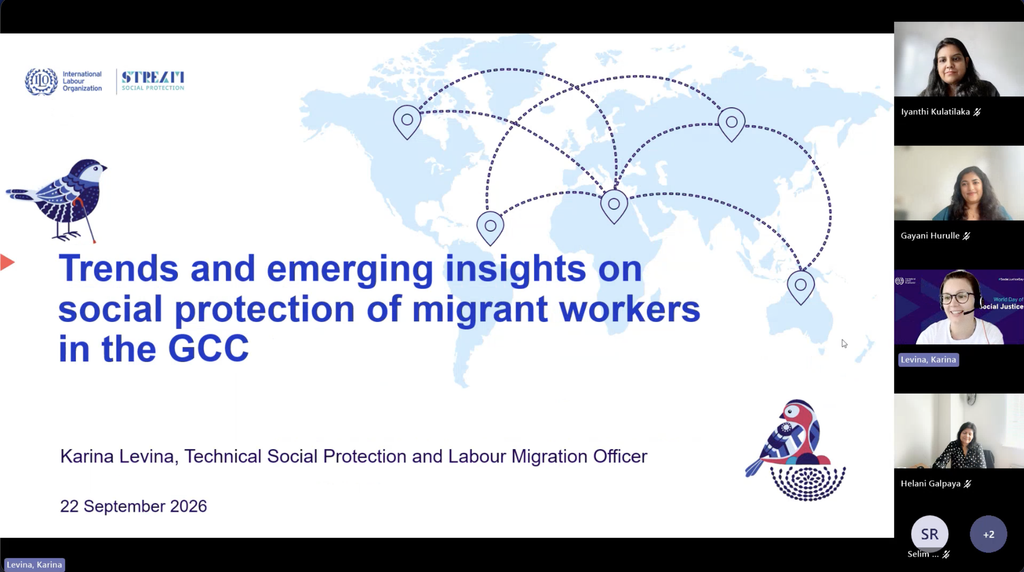
These issues were the focus of a FutureWORKS Asia knowledge-sharing session held on 22 September 2026, featuring Ms. Karina Levina, Technical Social Protection and Labour Migration Officer at the International Labour Organization (ILO), based in Nepal. The session, Trends and Emerging Insights on Social Protection of Migrant Workers in the GCC, examined persistent gaps in protection and recent reforms across the Gulf, drawing on the work of the ILO’s STREAM Programme – Extending Social Protection to Migrant Workers and Their Families in the South Asia–Gulf Corridor.
Social protection is part of human rights and decent work agenda
Social protection helps people manage risks; it includes access to healthcare and income support during sickness, unemployment, maternity, workplace injury and disability, as well as in old age.
As Ms. Levina explained, social security is a human right. International labour standards provide important benchmarks for extending protection to migrant workers, including equality of treatment between nationals and non-nationals and the maintenance of social security rights across borders.
Yet migrant workers are often excluded from protections available to nationals, despite their contributions to destination-country economies. The consequences extend beyond individual workers. Without income support during illness or injury, workers may be forced to continue working, borrow money or depend on their families. When workers return home without the benefits they expected and are entitled to, households that rely on their earnings can also face financial hardship.
Extending social protection to migrant workers is therefore not simply a welfare issue. It is a matter of rights, decent work and social justice. It can reduce poverty and inequality, support workers’ health and productivity and foster fairer labour markets and attract and For countries of destination, more inclusive social protection systems can also help attract and retain workers skilled workers, strengthen labour market resilience and contribute to more sustainable and competitive economies.
When protection depends on the employer
One of the key challenges Ms. Levina identified is the difference between the protection available to national and migrant workers in many GCC countries.
In the Gulf, national have access to social insurance systems that pool contributions and provide benefits when particular risks arise. Migrant workers, by contrast, may depend on employers paying compensation directly and may be excluded from certain benefits. This reflects a broader structural distinction between social insurance, which pools risks and resources across workers and employers, and employer-liability arrangements, under which individual employers are directly responsible for meeting certain obligations, often only when a particular event occurs.
While employer-liability arrangements can provide important legal entitlements, they may leave workers exposed when employers are unable or unwilling to fulfil their obligations. They also do not necessarily offer the same adequacy, predictability, continuity of protection as social insurance systems.This can leave workers vulnerable even when legal entitlements exist. They may struggle to obtain end-of-service payments, receive compensation for workplace injuries or navigate complex claims procedures.
The kafala sponsorship system has historically reinforced some of these challenges by linking workers’ residency and employment status to a specific employer, limiting their ability to change jobs or leave difficult working situations. Although labour mobility reforms have been introduced in several GCC countries, employer dependence and restrictions associated with migration status can continue to affect workers’ ability to exercise their rights, including access to social protection.
These gaps are particularly significant for domestic workers, workers in small enterprises and those in less secure employment arrangements, for example workers on the so-called “free visas”. Women migrant workers can face additional disadvantages because they are disproportionately represented in domestic work. The private-household setting, isolation from support services and dependence on employers can make it especially difficult for domestic workers to access information, report violations or pursue claims. The growth of platform work adds another challenge: responsibility for providing protection may be unclear when workers operate through platforms, sponsors and intermediaries. hese emerging forms of employment underscore the need for social protection systems that respond to changing labour markets without leaving workers outside their coverage.
The gap between entitlement and reality
One of the key points emphasised at the session was the difference between being entitled to a benefit and actually receiving it. Ms. Levina presented findings from a 2023 survey of Nepali migrant workers in the GCC. Around 42% of those surveyed had not received their end-of-service gratuity, a payment associated with the end of employment. The figure rose to 63% among lower-income workers and approximately 70% among women. Around 40% of respondents also reported paying for employment-injury treatment themselves, despite provisions intended to cover these costs.
These figures illustrate the persistent gap between legal entitlements and effective access to social security rights and benefits. These figures illustrate how social protection gaps can undermine the financial security workers seek through migration. They also point to unequal outcomes, while also revealing significant inequalities in access, particularly among women and lower-income earners.
Ms. Levina cautioned that the survey was conducted in 2023 and may not reflect the current situation. Nevertheless, its findings highlight a persistent concern: legal entitlements offer limited security if workers cannot access the benefits they are owed.
Effective access depends on the institutions and procedures through which benefits are delivered. Workers need accessible information, straightforward registration and claims processes, appropriate documentation, and practical mechanisms to seek redress. These challenges can be particularly acute for workers with limited language skills, those in informal or irregular situations, and those who have already left their country of employment.
The problem can become more complicated when workers return home. Without effective arrangements between countries, they may struggle to claim payments or maintain benefits earned abroad. This is why strengthening the administration and delivery of social protection is as important as extending legal coverage. Rights need to remain meaningful throughout the migration cycle, including after workers return home.
Reforms offer a path forward
Despite these challenges, Ms. Levina highlighted growing momentum for social protection reforms across the Gulf. Countries are taking different approaches, but some are moving away from systems in which workers depend primarily on individual employers to pay compensation.
Oman offers a particularly promising example. The country’s landmark 2023 Social Protection Law, developed with ILO technical support, marks a significant shift towards a more inclusive and integrated social protection system. For migrant workers, the reforms progressively extend social insurance protection against risks such as sickness, maternity and employment injury, while introducing a centrally administered provident fund to replace traditional employer-liability arrangements for end-of-service benefits. These changes represent an important step towards narrowing the longstanding gap in protection between national and migrant workers.
One particularly significant development is the planned extension of employment injury insurance to migrant workers, replacing reliance on individual employers with a collectively financed system. Under the new framework, from July 2028 workers experiencing permanent disability would be eligible for periodic compensation, including disability pensions, rather than relying solely on one-off payments. This could provide greater income security for workers and their families, particularly in cases of serious injury with long-term consequences.
Importantly, reforms in Oman also set a significant precedent in the GCC, offering a promising example of how social protection can be progressively extended to migrant workers and potentially inspiring similar reforms in other countries across the region.
Other developments include changes to maternity protection in Saudi Arabia and reforms in Bahrain to move end-of-service payments towards administration through its Social Insurance Organization (SIO). The United Arab Emirates has introduced a private unemployment insurance, offering eligible workers income support for up to three months following job loss. While a positive step, its limited benefit duration, eligibility restrictions and reliance on individual premiums paid by workers raise concerns about the adequacy and inclusiveness of protection.
These reforms differ in design and coverage, and changes in law do not guarantee that workers will receive benefits in practice. However, they show that governments are exploring ways to make protection more systematic and less dependent on individual employers.
The next challenge is to ensure that these provisions reach workers when they need them, particularly those in domestic work, lower-income employment and less secure working arrangements. It is also important to ensure that newly established systems work effectively for migrant workers whose employment may be temporary, whose contributions may be interrupted, or who may return home before reaching the age or conditions required to claim certain benefits.
Why this matters for South and Southeast Asia
For countries such as Sri Lanka, Bangladesh, India and the Philippines, social protection in the Gulf is closely linked to household economic security back home. Remittances help families meet everyday expenses, finance education and manage financial uncertainty. When migrant workers lose income, face high medical costs or return without benefits they expected to receive, their families have to bear the consequences.
Yet remittances, while essential to many households, are not a substitute for social protection. Migrant workers and their families should not have to rely solely on private savings or informal support when workers experience risks that social security systems are intended to address.
Protecting migrant workers therefore requires cooperation between countries of origin and destination. Ms. Levina noted that, at the time of the session, there were no social security agreements between South or Southeast Asian countries and GCC countries. While some bilateral labour migration agreements include certain references to social protection rights and entitlements, these provisions often remain limited in scope, lack concrete implementation arrangements and are difficult to monitor and enforce in practice.
And while social security agreements can be important instruments for extending social protection across borders, including through the recognition of insurance periods, the preservation of acquired rights and the payment of benefits abroad, comprehensive portability arrangements can be legally, technically and politically complex, particularly where social protection systems differ substantially in their design and coverage.
This does not mean countries must wait for comprehensive agreements before taking action. Practical forms of administrative cooperation such as exchanging information on employment and contribution records, establishing institutional focal points, and assisting workers with cross-border claims can make an immediate difference. These incremental steps can also lay the groundwork for more comprehensive social security coordination in the future.
Stronger coordination could help workers claim benefits earned abroad and reduce the risk of losing entitlements when they return home. Countries of origin also have a role in helping workers understand their rights before departure and access information and assistance while overseas.
Several South Asian countries have developed their own arrangements for migrant workers, including migrant welfare funds, mandatory insurance and dedicated social security schemes. These can provide valuable protection, particularly where gaps remain in destination-country coverage. However, origin-country measures often face limitations in financing, coverage, benefit adequacy and institutional coordination.
A key priority is therefore to make these measures more coherent with national social protection systems, rather than developing fragmented, parallel arrangements for migrant workers. At the same time, origin-country initiatives should complement, not replace, the responsibilities of destination countries and employers to provide social protection.
This is a central focus of the ILO STREAM Programme, which supports migrant-inclusive reforms in countries of origin and destination, improves effective access to existing entitlements, and promotes cooperation across the South Asia–Gulf corridor. Its approach recognizes that extending social protection across borders requires progress on several fronts: stronger national systems, more effective implementation, and sustained dialogue between countries of origin and destination.
These questions are increasingly relevant to the future of work. Digitalisation, new employment arrangements, demographic change and climate-related transitions are reshaping labour markets. Workers who cross borders may have to navigate these changes while dealing with different legal systems and gaps in protection.
For FutureWORKS Asia, the session reinforced a key point: the quality of work cannot be measured by employment opportunities alone. It also depends on whether workers can access healthcare, recover from injury, manage periods without income and retain the benefits they have earned.
Ultimately, social protection should not stop where national borders begin. Ensuring that migrant workers and their families are protected requires countries to look beyond individual employment contracts and towards more inclusive, coordinated and sustainable systems of social security.
Migration should offer more than a job. It should provide a fair opportunity to build a more secure future for workers and their families. Making social protection accessible across borders is an essential part of that goal.