
 This past week, our friends from the Rural Technology and Business Incubator (RTBI) of the Indian Institute of Technology showcased the Real-Time Biosurveillance Program (RTBP) at the Connect 2008 exhibition hosted in Chennai, India from September 11-13. The theme of this year’s event, which is the 8th episode, is – Global Competitiveness and Equitable Growth-Driven by Innovation”. The action research: Evaluating a real-time Biosurveillance program, being pilot tested in the state of Tamil Nadu, India and the District of Kurunegala, Sri Lanka over the next 2 years to come is an innovation emphasizing m-Health. The two ladies: Geetha G (left) and Suma Prashanth (right) in the news articel are managing the RTBP project in India, which includes developing the technology and piloting the ICT system with Village Health Nurses in rural Tamil Nadu.
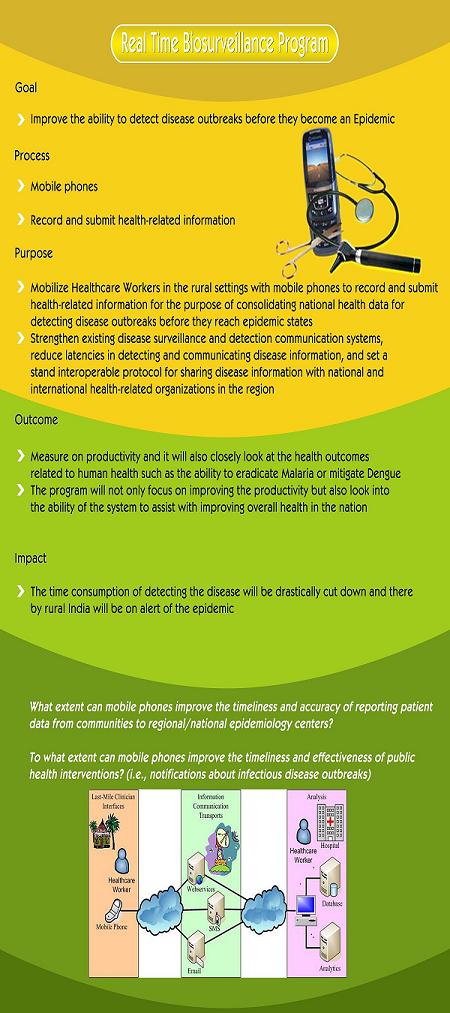
At present, the technology partners RTBI, Auton Lab (USA), and Lanka Software Foundation (Sri Lanka) are jointly working on developing the end-to-end disease surveillance and notification software applications. RTBI is developing the J2ME mobile application that can push health related information to a datacenter. Auton Lab has taken on the challenge to develop the automated disease outbreak detection algorithms that are expected to rapidly detect disease outbreaks using trained Bayesian network algorithms that take less time than humans can, to look for outliers in trends over geospatial dimensions. LSF is extending its Sahana suite of disease surveillance modules for data warehousing as well as the Sahana Messaging Module for alerting healthcare workers of eminent health threats.
Next month the project will be meeting with the community and government healthcare workers in Indian and Sri Lanka to define the user requirements. The meeting in Sri Lanka will take place on October 7th in Kuliyapitiya at the Medical Officer of Health office auditorium. The program entails demonstrating the concept to the particiapnts to get an initial feel of the technology thereby obtain feedback before the technology partners develop the full fledged solutions.
2 Comments
magnum
Rural health in India is in a very bad shape, and steps taken by government is not at all sufficient.We need some big private sectors to help these villages in the name of social cause.
Suma
Agreed that the Health Status in Rural India is not very good. To make a difference, public-private partnership approach is needed. Especially if one is trying to make a difference in this tier of society wherein affordability and reach is a question.
Rethinking Sri Lanka’s Data Centre Hub Ambition
The idea of turning Sri Lanka into a regional data centre hub is an attractive one, particularly in the context of growing global demand for digital infrastructure and AI-driven services. However, it raises important economic questions, especially whether this is a viable and high-return investment strategy for a small, fiscally constrained economy like Sri Lanka.
Nepal’s digital crossroads: building a transparent data governance framework
Nepal’s evolving digital landscape highlights a growing tension between constitutional guarantees of privacy and access to information, and a fragmented, outdated data governance framework. In a recent article published in Republica on March 17, 2026, Avash Mainali, Country Researcher for Nepal for LIRNEasia’s D4D Asia project, argues that while the introduction of the Personal Data Protection Policy, 2082 (2025), marks a positive step, its impact will depend on whether it can move beyond aspirational language to enforceable rights.
LIRNEasia CEO Helani Galpaya Shares Insights on AI and Labour at ISLE Conference 2026
Artificial intelligence is rapidly transforming labour markets worldwide. In the Global South, however, these changes are unfolding unevenly, shaped by labour markets defined by high levels of informality, uneven social protection, and large skills gaps.
Links
User Login
Themes
Social
Twitter
Facebook
RSS Feed
Contact
9A 1/1, Balcombe Place
Colombo 08
Sri Lanka
+94 (0)11 267 1160
+94 (0)11 267 5212
info [at] lirneasia [dot] net
Copyright © 2026 LIRNEasia
a regional ICT policy and regulation think tank active across the Asia Pacific