
 m-Health Real-Time Biosurveillance Program (RTBP) interviewed Medical Officers in Kurunegal District in Sri Lanka and Sivagangai District in Tamil Nadu, India, during the months of September and October, 2009. These interactions revealed that outpatient health record entry in real-time by Medical Officers, using the mobile phone key pad is inefficient and the idea was rejected by them. The aim of the RTBP is to collect digitized patient disease, syndrome, and demographic information from the point of care to rapidly detect disease outbreaks.
Village Health Nurses in Tamil Nadu examine at most 70 patients a week. Ninety percent of the Village Health Nurses opt to jot down the records on paper and later enter them leisurely after the day’s work is complete. Therefore, they can easily use a mobile phone for data entry. However, the same solution cannot be applied to Primary Health Centers (Clinics) or Hospitals because they cater to as much as 200 patients a day within a span of 5 hours (8am – 1pm), giving the Medical Officers just about 90 seconds to examine each patient. Although the m-HealthSurvey mobile application offers the users to mostly select data opposed to typing, some editing of symptoms and signs are required. Hence, it is near impossible to request that the Medical Officers enter each patient record in real-time while they are overwhelmed with caring of patients.
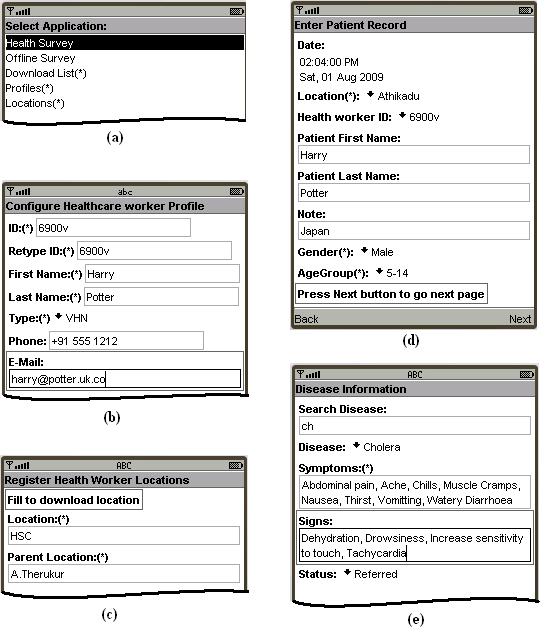
 Medical Officers are still required to pencil the patient’s health ID, age, gender, and diagnosis in the OPD registry. The present day protocols require that the Hospital and Clinic staff extract the OPD data for weekly reports that are propagated up through the District to State/Province and finally to the National level. The extra steps of aggregating and consolidating records manually at each level can be eliminated and delays that are as long as 30 days can be minimized to real-time, if the health records are digitized at the point of care.
At present the RTBP has recruited staff to digitize that data using the m-HealthSurvey for the purpose of the pilot. The RTBP research has realized two options for digitizing health records at the point of care: 1) recruit additional staff to enter health records (similar to what is being done now in the pilot) or 2) develop a mobile handheld device with touch screen and handwritting recogniztion for Medical Officers. Option 1) is costly since it involves additional human resources. Option 2) is ideal, if a handheld devices, similar to the mobile wireless medical tablet, can be developed for aound US$100, the same price as the mobile phones used in the RTBP field work at present.

5 Comments
flaggerbastard
Wow, thanks! I was about to start a large scale BPO operation doing data entry with mobile phones! Thanks to your groundbreaking research, I have decided to switch to keyboards…
waidyanatha
we are investigating the possibility of using voice as an alternative though IVR with speech-to-text conversion and parsing data for categorizing information. Would be faster than using a mobile key pad but may not be as fast as a qwerty keyboard.
A recommendation, if you have the money, to use slightly expensive mobile phones with qwerty key pad displayed on touch screen. If bought in China will be cheap.
Document scanning Virginia
Text-to-speech technology is evolving with a more efficiency and reliability. Where data entry is concerned, one should take this into consideration. Mobile phone data entry are good on a small scale.
Nepal’s digital crossroads: building a transparent data governance framework
Nepal’s evolving digital landscape highlights a growing tension between constitutional guarantees of privacy and access to information, and a fragmented, outdated data governance framework. In a recent article published in Republica on March 17, 2026, Avash Mainali, Country Researcher for Nepal for LIRNEasia’s D4D Asia project, argues that while the introduction of the Personal Data Protection Policy, 2082 (2025), marks a positive step, its impact will depend on whether it can move beyond aspirational language to enforceable rights.
LIRNEasia CEO Helani Galpaya Shares Insights on AI and Labour at ISLE Conference 2026
Artificial intelligence is rapidly transforming labour markets worldwide. In the Global South, however, these changes are unfolding unevenly, shaped by labour markets defined by high levels of informality, uneven social protection, and large skills gaps.
LIRNEasia CEO Helani Galpaya at the Global South Policy Dialogue: Securing Labour Justice in the Age of AI
As Artificial Intelligence (AI) continues to transform the world of work, its impacts in the Global South present urgent and unique challenges. Unlike advanced economies with formal labour markets and stronger safety nets, many countries in the Global South face high levels of informality, limited social protection, and unequal access to skills and digital infrastructure.
Links
User Login
Themes
Social
Twitter
Facebook
RSS Feed
Contact
9A 1/1, Balcombe Place
Colombo 08
Sri Lanka
+94 (0)11 267 1160
+94 (0)11 267 5212
info [at] lirneasia [dot] net
Copyright © 2026 LIRNEasia
a regional ICT policy and regulation think tank active across the Asia Pacific