

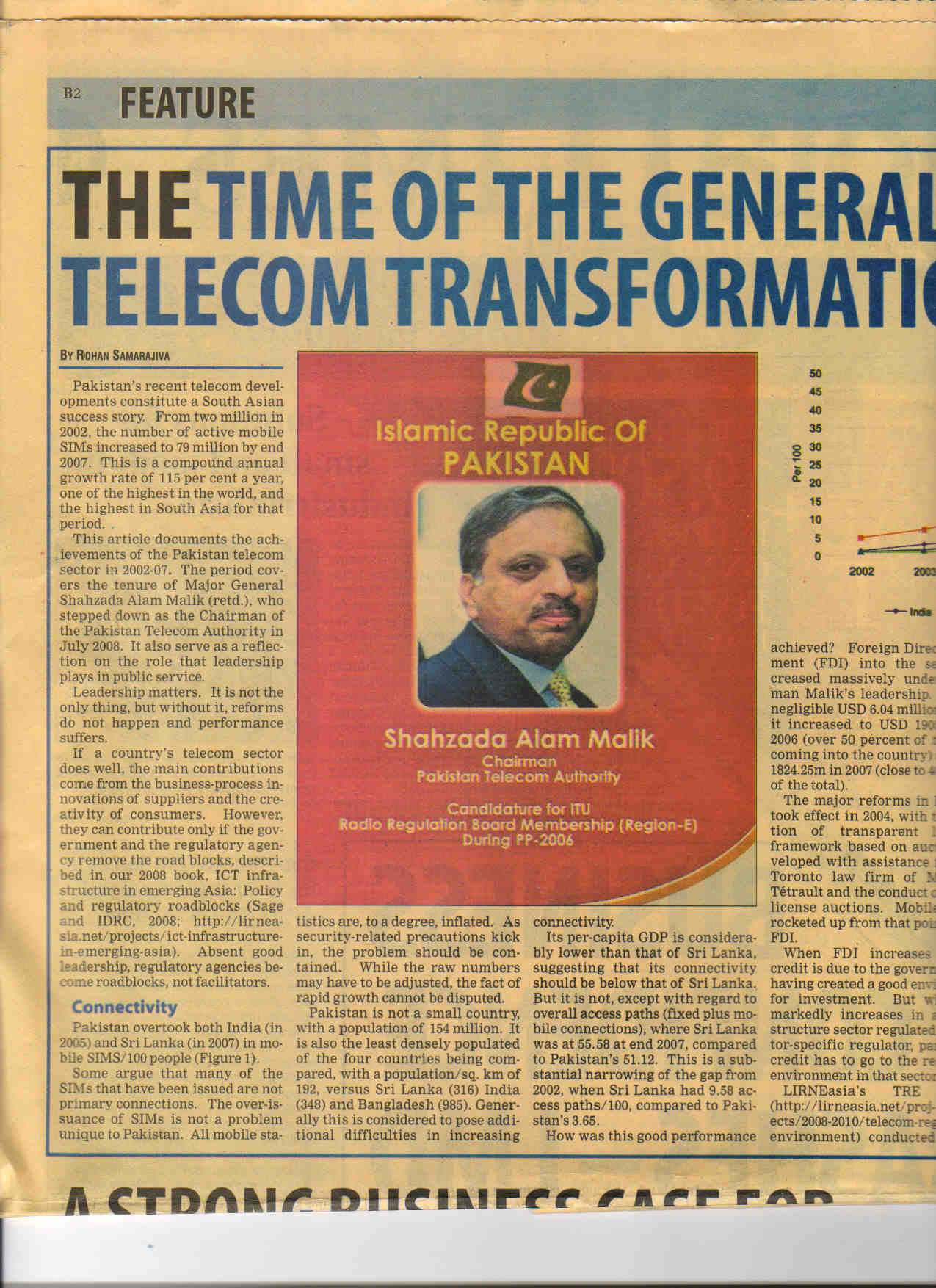
A few days ago, we learned that Major General Shahzada Alam Malik (Retd.) had stepped down from the leadership of the Pakistan Telecom Authority. We believe that his seven-year tenure at the helm of the PTA merits an assessment. It begins thus:
Pakistan’s recent telecom developments constitute a South Asian success story. From two million in 2002, the number of active mobile SIMs increased to 79 million by end 2007. This is a compound annual growth rate of 115 per cent a year, one of the highest in the world, and the highest in South Asia for that period.
The full document is Pakistan’s telecom transformation, 2002-07
We fully realize that readers, especially from Pakistan, may have varying views on whether or not Pakistan’s telecom sector was transformed, whether the PTA played a constructive role, and whether Major General Malik provided good leadership. We have made our assessment based on the available evidence. We welcome comments and debate.
3 Comments
Chanuka Wattegama
We get some reference. http://telecompk.net/2008/07/31/pta-leadership-performance-analysis-by-lirne-asia
Rohan Samarajiva
A short version of this has been published in the leading Sri Lanka English newspaper: http://www.dailymirror.lk/DM_BLOG/Sections/frmNewsDetailView.aspx?ARTID=22275
Rohan Samarajiva
Another mention: http://telecomgrid.blogspot.com/2008/08/pta-leadership-performance-analysis.html
Rethinking Sri Lanka’s Data Centre Hub Ambition
The idea of turning Sri Lanka into a regional data centre hub is an attractive one, particularly in the context of growing global demand for digital infrastructure and AI-driven services. However, it raises important economic questions, especially whether this is a viable and high-return investment strategy for a small, fiscally constrained economy like Sri Lanka.
Nepal’s digital crossroads: building a transparent data governance framework
Nepal’s evolving digital landscape highlights a growing tension between constitutional guarantees of privacy and access to information, and a fragmented, outdated data governance framework. In a recent article published in Republica on March 17, 2026, Avash Mainali, Country Researcher for Nepal for LIRNEasia’s D4D Asia project, argues that while the introduction of the Personal Data Protection Policy, 2082 (2025), marks a positive step, its impact will depend on whether it can move beyond aspirational language to enforceable rights.
LIRNEasia CEO Helani Galpaya Shares Insights on AI and Labour at ISLE Conference 2026
Artificial intelligence is rapidly transforming labour markets worldwide. In the Global South, however, these changes are unfolding unevenly, shaped by labour markets defined by high levels of informality, uneven social protection, and large skills gaps.
Links
User Login
Themes
Social
Twitter
Facebook
RSS Feed
Contact
9A 1/1, Balcombe Place
Colombo 08
Sri Lanka
+94 (0)11 267 1160
+94 (0)11 267 5212
info [at] lirneasia [dot] net
Copyright © 2026 LIRNEasia
a regional ICT policy and regulation think tank active across the Asia Pacific