

One local telco CEO recently whined about being viewed as a cigarette manufacturer. “Everybody wants to tax us, as if mobiles are a product more hazardous than cigarettes. Tobacco kills, mobiles don’t; communication facilitates better living conditions and saves environment because it reduces transport. It is gross unfair both are seen in the same light.”
As Wikipedia tells us, cigarettes are a significant source of tax revenue in many localities. This fact has historically been an impediment for health groups seeking to discourage cigarette smoking, since governments seek to maximize tax revenues. It is established that higher prices for cigarettes discourage smoking. Every 10 percent increase in the price of cigarettes reduced youth smoking by about seven percent and overall cigarette consumption by about four percent.
We hope Udaya Prabhath Gammanpila, Chairman Central Environmental Authority, will take note. If you think we use too many mobile phones – yes, taxing usage is the ideal path to bring it down. If not, you are making a dangerous precedent.
Taxing mobile usage by one ministry is an ‘open sesame’ for the rest. Ministry of Health can claim mobiles cancerous. Ministry of Education will find them disrupting studies. Perhaps the ever vigilant Ministry of Women’s Affairs may link mobiles to teen pregnancies – a correlation we would have never know if not for the District Secretary of Badulla. Given the other remarks he makes, to hear IGP saying mobiles increase crime will not surprise us. Almost forgot it – Telecommunication Regulatory Commission itself thinks mobiles are a prime reason for increased terrorist activities.
Bravo! Why not all these gentlemen and ladies tax mobile usage 2% each? (After all, it is about Rs. 10 per month for many, the price of a cup of tea.)
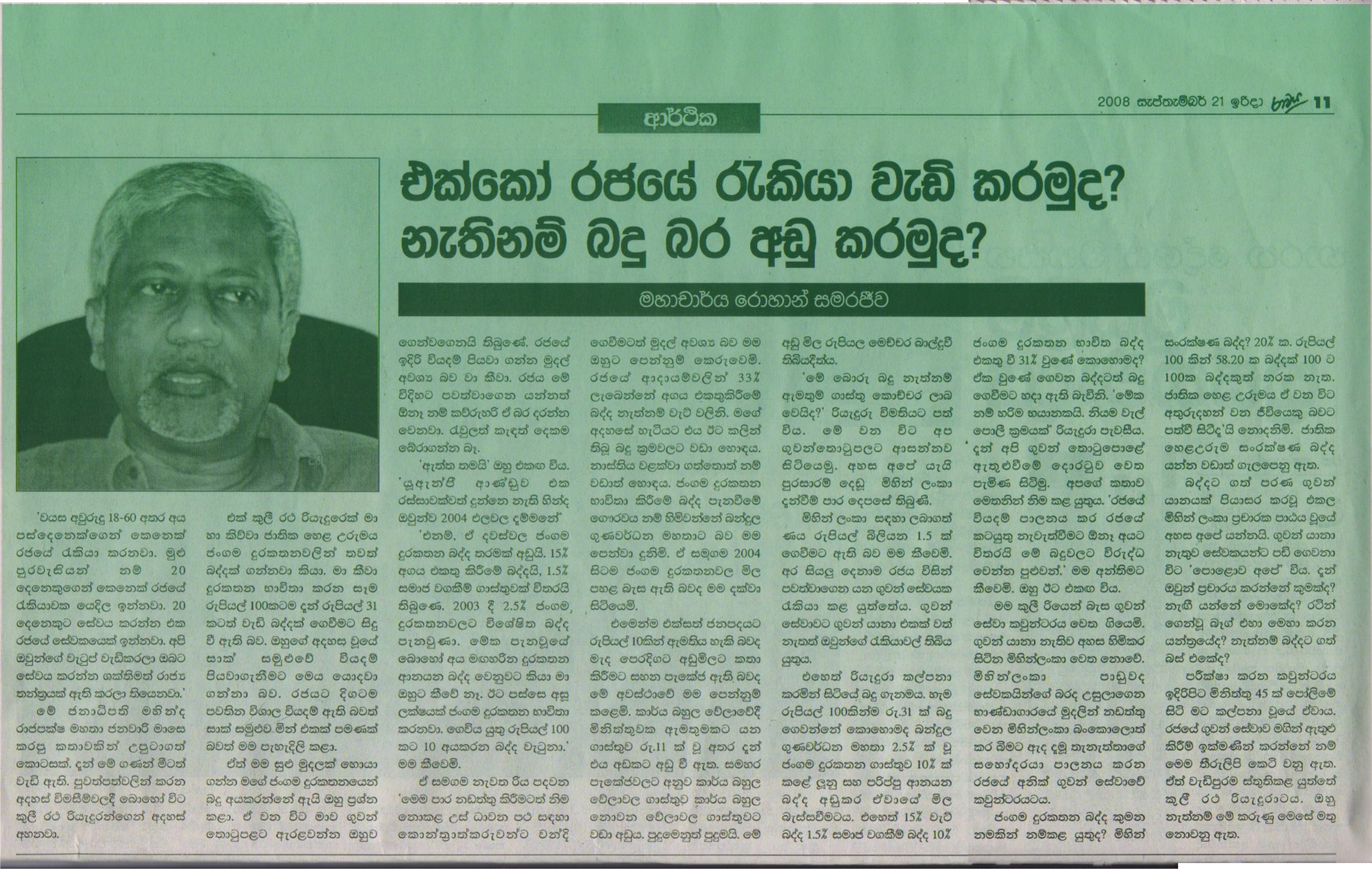
By the way, Rohan Samarajiva, LIRNEasia’s Executive Director had been busy for the past few weeks in making his case against ‘Envy Levy’ for mobile usage. We reproduce two of his articles here to Ravaya and Lankadeepa, in case The Chairman CEA had missed them. (Udaya, please click on images to get a full view)

Article on 'Ravaya'

Article on 'Lankadeepa'
(The cartoon above by Asanga Indunil of Rivira.lk, Aug 17, 2008)
7 Comments
Mark
50 years ago we did not know that cigarette smoking could be harmful. In 10-20-30 years time we may find that mobiles cause similar or worse problems.
Optimist
Dear Mark,
So would the vegetables you eat as it is full of pesticides and Chemical fertilizer, So would the vehicle you drive as it is emitting Lead and other hazardous material to Air, So would the electricity you consume, The clothes you wear, etc. etc. which get produced in factories around the world which emit CO2 causing Global Warming, etc. etc. etc.
So is taxing the way to save the world????
Or is it the way to fatten the politicians who do not give a damn????
Rohan Samarajiva
I have only two things against smoking. Humans have always taken mood-altering substances, so I have nothing against them in principle.
As anyone who has smoked knows, cigarette smoking is addictive. It impairs the decision making ability of the individual. That is why I do not smoke, but do take non-addictive mood-altering drugs (i.e., alcohol) periodically. As far as I know, mobile use for voice does not seem to have any addictive properties. The Koreans seem to think that the Internet has and have established some kind of organization to deal with it.
Smoking also has negative externalities, in that people who do not smoke but are in the proximity of smokers suffer negative health outcomes. There are a few negative externalities from having mobile users loudly spill out the gory details of their lives in one’s hearing, but that cannot be equated with contracting lung cancer.
Then what remains is the faint possibility (not proven by science in any way) of the mobile user getting his/her brain fried (if using the phone against the ear) or other vital body parts toasted if keeping the phone at waist level and using an earpiece. That is a choice; it should be respected. People eat bad stuff; do not exercise; go on pilgrimage to Kataragama on dangerous roads during tsunamis; etc. They do foolish things and they die. That is their inalienable right. We must respect that.
So I disagree that even a remote parallel exists between smoking and using mobile for voice. The only parallel seems to be government’s insatiable desire to tax the hell out of cigarettes in the past and mobile use in the present.
brendan
I agree with some of these observations, but wish to correct other assertions. First, alcohol /is/ universally considered addictive, though not as quickly habit-forming as nicotine or opiates; mostly users of any of these do not become addicts, however. Second, mobile phones have both addictive properties (especially smart phones) and externalities. A substantial and growing body of studies show nuggets of info, and even sugar, trigger the brain’s reward centre quite like any other drug. And, even if one imagines oneself immune to the focus-sapping and conversation-hobbling effects of one’s own phone chimes, the chiming of others’ phones and is shout-into-the-mic habits of those around one are noise pollution (an externality). Finally, no evidence supports significant ill effects for those near an outdoor smoker; and evidence against second-hand smoke is even scant for less-confined, less smoke-dense indoor spaces than small, hazy pubs. I still support smoking bans indoors, though. It’s unhealthy even at moderate use and — while not in fact at all damaging to clarity of thought — nearly as annoying to a non-smoker as not cleaning feces off one’s shoes.
Rohan Samarajiva
Breaking news: the Supreme Court has issued a stay order on the envy levy. Now the burden shifts to the government lawyers to justify why the stay should be lifted. Democratic processes are still at work in Sri Lanka!
MillenStore
Mark, i agree – “50 years ago we did not know that cigarette smoking could be harmful. In 10-20-30 years time we may find that mobiles cause similar or worse problems.” We smoked and to smoke we shall be. Thank You
brendan
There is evidence of harm to the brain development of children who use mobile phones heavily, but nothing conclusive yet (despite many studies) of significant harm to adults. We may yet find mobile-frequencies harm adults somewhat, but it is unlikely to outweigh their benefits; and will never be found to be as silly (real damage with almost no benefit) as smoking. We adults are bags of complaints and, all too often, careless blame-throwers; equally likely to blame an un-powered cell tower or wi-fi access point for an ill as a working one.
LIRNEasia Senior Research Manager Gayani Hurulle at the Internet Governance Forum Sri Lanka 2026
The Internet Governance Forum Sri Lanka (IGF Sri Lanka) 2026 was held on 23 September under the theme ‘Empowering the Internet in the Age of Intelligence through Multistakeholderism’. The event brought together stakeholders from government, industry, academia, civil society and the technical community to discuss key issues in internet governance.
Is Personally Identifiable Information safe in the hands of the State?
In an article published on 25 September 2026 in the DailyFT, LIRNEasia Chair Professor Rohan Samarajiva discusses the risks of the state holding large amounts of personally identifiable information (PII). He looks at the misuse of electoral-registry information during the July 1983 pogrom, which critics of public-service digitalisation, particularly the Sri Lanka Unique Identity (SLUDI), cite as a reason for extreme caution, if not halting such initiatives.
LIRNEasia is hiring: Senior Researcher
LIRNEasia is looking for a talented individual to join the team as a Senior Researcher to drive impactful research. The full job description can be accessed below.
Links
User Login
Themes
Social
Twitter
Facebook
RSS Feed
Contact
9A 1/1, Balcombe Place
Colombo 08
Sri Lanka
+94 (0)11 267 1160
+94 (0)11 267 5212
info [at] lirneasia [dot] net
Copyright © 2026 LIRNEasia
a regional ICT policy and regulation think tank active across the Asia Pacific